Seasonal
What Winter on the Bench Does to a Delivery
The valley floor and the bench are two different climates on the same day, and the difference decides whether we can reach your driveway.
Two climates, ten minutes apart
Draper sits at the south end of the Salt Lake Valley at the foot of the Wasatch, and the weather here is not one weather. The valley floor, the bench and the canyon mouths can be doing genuinely different things on the same morning.
A storm that leaves an inch on the flat can leave several times that on the upper bench. Ice persists on shaded bench streets for days after the valley floor has dried. And ten minutes up the road in Cottonwood Heights or Alpine, the picture changes again.
None of that stops us delivering. It does change what we need to know before we set out, and the single most useful thing you can tell us is which part of the hill you are on.
⚠️ Grade is the real constraint
This is the one that genuinely differs from a flat market, and it is worth taking seriously.
Bench and foothill properties across Draper, Cottonwood Heights, Alpine and Cedar Hills routinely have driveways steep enough to matter. Add ice and the margin disappears.
What helps:
- Tell us the grade when you book, not on delivery day. "It is steep" is enough — we will ask the follow-up questions.
- Clear and salt the placement area and the approach before the window.
- Be open to a flatter placement. A container at the bottom of the drive that we can actually collect beats one at the top that we cannot.
- Accept that we may reschedule. We would rather move a delivery than put a loaded truck somewhere it should not be.
Snow banks narrow everything
A driveway that comfortably takes a 20 yard in September may not in January.
The numbers: a 20 yard is twenty-two feet of container and the truck needs roughly ten more feet of clear run behind it to set it down and pick it up. A 15 yard takes six feet less on the ground.
Now add winter:
- Plowed snow narrows a driveway by a foot or more on each side, and it compacts into something closer to ice than snow.
- Street plow banks can block the approach entirely.
- Turning space shrinks everywhere at once, which matters more than the driveway itself on the tighter bench streets.
The practical answer is often a 15 yard with a swap where a 20 would have gone in summer. Same total volume, a shape that actually fits.
Snow and ice are weight you pay for
Disposal is charged by the ton, and an open container left through a snowfall collects it.
A 20 yard with several inches of wet snow across the load is carrying real weight that has nothing to do with your project — and if it thaws and refreezes it becomes ice, which is heavier again and does not drain out.
Two things help: ask about a cover if the container will sit across several days, and load and go rather than letting it stand for three weeks.
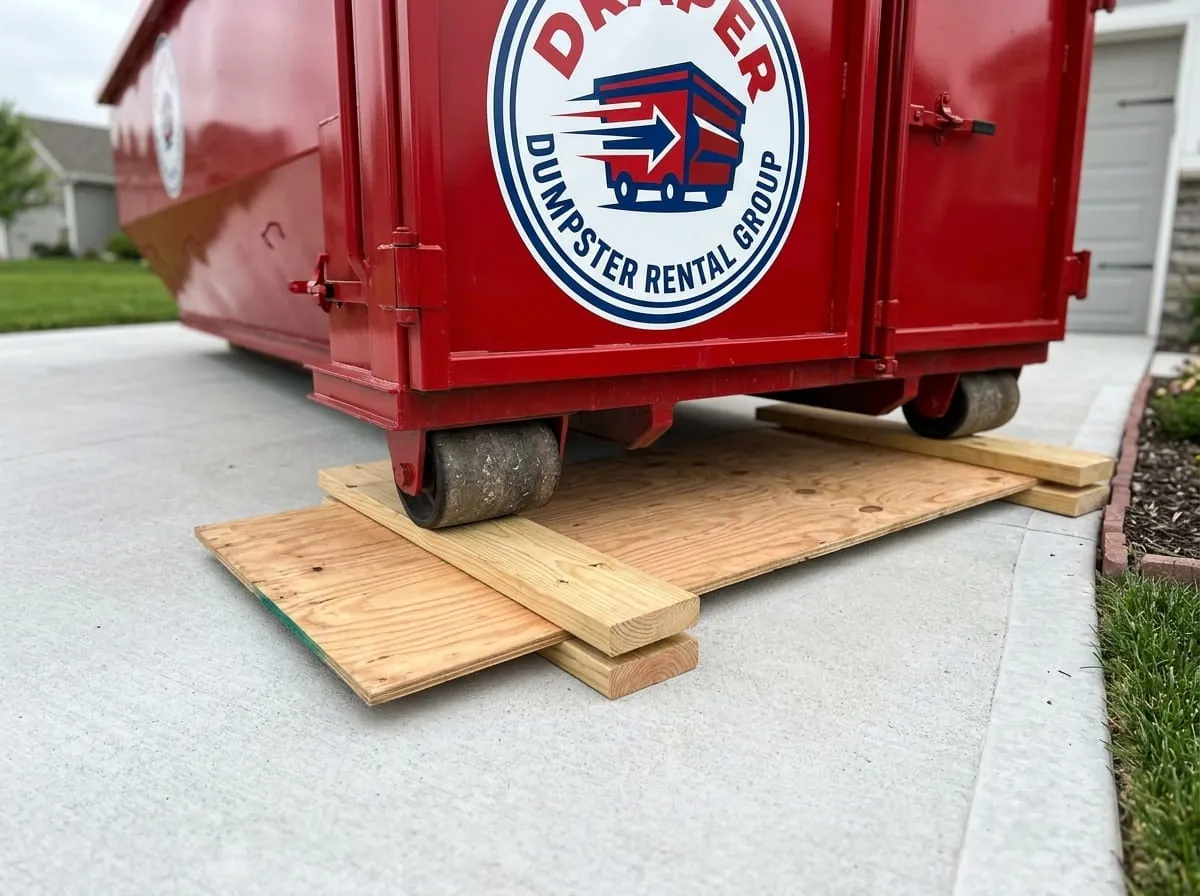
The same freeze-thaw cycle can weld a container to a driveway. Meltwater runs under the rails during a warm spell and refreezes overnight. Boards under the rails — standard on every delivery — protect the surface and break that bond.
⚠️ The inversion and what it changes
The genuinely local one, and something people moving here are never quite prepared for.
For stretches of winter, a layer of warm air settles over the valley and traps cold air and everything in it underneath. The inversion can hold for days or weeks, and during it the air quality in the valley degrades badly while the mountains above sit in clear sunshine.
What it means for a project:
- Burning is not an option. Not brush, not scrap timber, not anything. During an inversion it is both worse for everyone and likely restricted — and it was never a legitimate disposal route regardless.
- Dusty work deserves more care. Demolition, concrete cutting and sanding put particulates into air that is already holding everything else. Wet-cut, contain and time it sensibly.
- Working outdoors for days is harder on people during a bad inversion. Worth factoring into a self-managed clear-out.
- It is a reason the landfill and the city care about diversion. Less burning, less hauling, fewer trips.
If you were planning to deal with a brush pile by burning it, the container is not just the legal answer here, it is the neighbourly one.
Canyon winds and covered loads
The other local weather feature worth planning around.
Winds come down the canyons and across the Point of the Mountain hard enough to move loose material a long way. That matters in two places:
- Light debris in an open container — insulation, packaging, drywall offcuts, cardboard — will leave the box and end up in your neighbour's yard. Load light material low and put heavy material over it.
- Self-hauled loads must be fully covered and secured or you are charged double at the gate, and the wind here is exactly why that rule exists.
On a roll-off the covering is our job. On a trailer it is yours, and a proper tarp tied at all four corners is the difference between one gate fee and two.
Spring runoff and soft ground
Winter's other half.
As the snowpack comes off the Wasatch, the ground softens and the creeks run hard. For most driveway deliveries that changes nothing. It matters on:
- Unpaved approaches and acreages, particularly out toward Bluffdale and the Utah County side — a loaded truck on soft ground is a genuine consideration.
- Properties near a creek or a drainage, where the low ground stays wet for weeks.
- New construction sites before the hard standing goes in.
Tell us the surface and we will plan the approach rather than discover it.
Planning a winter job
- Tell us which part of the hill you are on and how steep the drive is
- Clear and salt the placement area before the delivery window
- Expect a 15 yard with a swap where a 20 would fit in summer
- Be open to a flatter placement than your first choice
- Ask about a cover for anything sitting several days
- Boards go down as standard — they break the ice bond
- Do not burn anything, and be careful with dusty work during an inversion
- Load light material low, heavy over it, because of the wind
- Self-hauling? Cover and secure, or pay double
- Build slack into any winter project with a fixed finish date
Need a container in Draper?
Call and describe the job. Three minutes on the phone gets you a size recommendation, a flat rate and a delivery window — and we will tell you if a smaller, cheaper container is the right answer.
Call (385) 338-5583